
CMSNE’s Annual Hospital Based Case Management Conference –
Essential Guide to Healthcare Changes and the Challenges in 2026:
Strategies and Solutions from National Experts
to be held virtually in two parts on Saturday, January 27 and February 7, 2026
REGISTRATION
2 Day conference 1/24 & 2/7/26
CMSNE member $95, CMSA member not part of CMSNE $105, Non-member $120
7.5 RN, SW & CCM credits for both days
Register here for 2 days 1/24 & 2/7/26
CMSNE members $60, CMSA members not part of CMSNE $70, Non-members $75
Day 1 – 1/24/26 – 3.75 RN, SW & CCM credits
Register here for 1/24/26
Day 2 – 2/7/26 – 3.75 RN, SW & CCM (1.5 CCM ethic) credits
Register here for 2/7/26
Reduced rates for groups of 5+, must all register and pay at the same time. Call chapter office for additional details.
ANY ISSUES REGISTERING FOR THIS OR ANY CMSNE EVENT CONTACT THE CHAPTER OFFICE AT
603-329-7481 OR CMSNE@COMCAST.NET

Ronald Hirsch, MD, FACP, CHCQM, CHRI
Dr. Hirsch’s Bio
Day 1 – January 24, 2026 Session I
Risks and Case Management Responsibilities for the 2026 Federal Policy Healthcare Changes
This presentation will discuss:
– Updates on 2026 Medicare regulation changes
– Against medical advice – What it means and the implications


Trancy Escobar, MBA, CMAC
Trancy’s Bio

Maryann Vienneau
Maryann’s Bio
Day 1 – January 24, 2026 Session II
The Management of Complex Patients Across the Care Continuum
This presentation will:
– Discuss the dynamic relationship between inpatient case management, the pathway through skilled nursing facilities and the ongoing comprehensive patient management in the community.

Dr. Ellen Fink-Samnick, DBH, MSW, LCSW, ACSW, CCM, CCTP, CRP, FCM
Day 1 – January 24, 2026 Session III
Navigating SDoH in this Current Healthcare Environment
This presentation will discuss:
- Shifts in laws and requirements are rapidly altering how the whole person approach to health is being addressed.
- How revisions to the industry affect clinical, fiscal, and operational outcomes for organizations and the populations served?
- Learn what case managers must know in these ever-changing times to inform their ethical, clinical, and administrative practices.
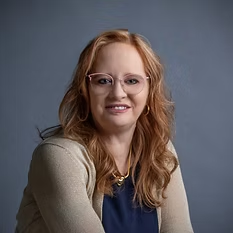
Colleen’s Bio
Day 2 – February 7, 2026 Session I
Leading Today, Shaping Tomorrow: The Top 10 Must-Haves for Case Management Leadership and Staff
This presentation introduces the Top 10 Leadership Must-Haves for Case Management.
- Examine each element as a current leadership necessity, compared to a foundational skill set for the development of future leaders.
- Leave with the tools to critically reflect on your own leadership practice, identify opportunities for growth.
- Design actionable steps to strengthen your personal leadership effectiveness and the future of case management leadership within organizations.

Tiffany Ferguson, LMSW, CMAC, ACM
Tiffany’s Bio
Day 2 – February 7, 2026 Session II
Case Management Models supporting Healthcare Changes
This presentation will:
– Examine the current case management model and how it could be effected by the recent changes in healthcare and the political landscape.
– Describe the SDoH changes and application to case management practice.
– Discuss the expansion of readmission avoidance expectations to Medicare Advantage Plans.







Jenny Quigley-Stickney. RN, BSN, MSN, MHA, MA, CCM, ACM-RN, CMAC, CPHM, FCM
Jenny’s Bio
Day 2 – February 7, 2026 Session III
Navigating Throughput Challenges with all Healthcare Team Members
This presentation will:
– Promote Hybrid staffing models for acute care case managers to manage the challenges with daily absenteeism
– Discuss the integration of telehealth, AI and EHR in daily collection of analytics to manage successful patient-centered care programs
– Articulate the challenges and considerations with coordination, communication and training staff within the hybrid model for case managers
Special thanks and appreciation to conference exhibitor sponsors, their support has allowed CMSNE the opportunity to bring a quality educational program to our membership. Acceptance of support from these sponsors in no way implies endorsement of their products and/or services by CMSNE or the program’s accreditation agencies.
2026 Sponsor Agreement Spaces are limited to 9 slots
 |
 |
 |
 |
 |
 |
 |